
 Hyundai Equus: Steering Angle Sensor Description and Operation
Second generation VI (2009–2026) / Hyundai Equus VI 2009-2026 Service Manual / Brake System / ESP(Electronic Stability Program) System / Steering Angle Sensor Description and Operation
Hyundai Equus: Steering Angle Sensor Description and Operation
Second generation VI (2009–2026) / Hyundai Equus VI 2009-2026 Service Manual / Brake System / ESP(Electronic Stability Program) System / Steering Angle Sensor Description and Operation
Second generation VI (2009–2026) / Hyundai Equus VI 2009-2026 Service Manual / Brake System / ESP(Electronic Stability Program) System / Steering Angle Sensor Description and Operation
| Description |
Steering Wheel Angle Sensor detects rotating direction of the
vehicle. Rotating direction detected by the sensor is communicated with
HECU as CAN signal involving information about the angle through CAN
communication line.
HECU detects speed of the steering wheel handling and the
angle with this CAN signal. HECU also uses this signal as the input
signal to control anti-roll.

Specification
| Description | Specification | |
| Operating voltage | 8 ~ 16V | |
| Operating temperature | -40 ~ 85°C | |
| Current consumption | Max.150mA | |
| Measuring range | Angle | -900 ~ 900° |
| Angular velocity | 0 ~ 1016°/sec | |
Circuit Diagram
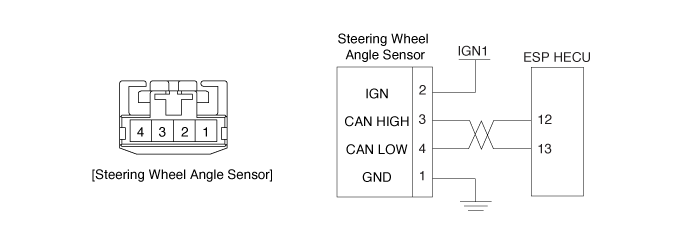
Calibration (Setting up the zero angle)
Steering Wheel Angle Sensor of a absolute angle type (CAN type) measures the angle under the standard of the zero angle set
Calibration must be performed as following cases.
| - |
Replacement of the Steering Wheel Angle Sensor |
| - |
Replacement or repair of the Steering column |
| - |
Detection of DTC codes (C1260, C1261) |
| - |
Replacement of the sensor cluster |
| - |
Replacement of HECU |
Calibration procedure
Perform wheel alignment and stand the steering wheel in a line within ±3°error.

| 1. |
Connect the GDS.(CAN line or OBD connector) |
| 2. |
Turn ignition switch on. |
| 3. |
Press calibration button of the Steering Wheel Angle Sensor. |
| 4. |
HECU calibration procedure is performed.
(Calibration records, DTC codes erasure) |
| 5. |
Turn ignition switch off after calibration procedure. |
| 6. |
Confirm success or failure of calibration.
|
 VSM OFF Switch Repair procedures
Removal
1.
Disconnect the negative (-) battery terminal.
2.
Remove the airbag module.
(Refer to Restraint - "Driver Airbag (DAB) Module and Clock Spring")
3.
Remove the TORX screws to rem ...

See also:
Rear combination lamp Repair procedures
Removal
1.
Disconnect the negative (-) battery terminal.
2.
Loose the nuts holding the rear combination lamp (outside) then disconnect the connector (A).
3.
Remove the rear combination la ...
Specifications
Specifications
DescriptionSpecificationsLimitGeneralTypeV-type, DOHCNumber of cylinders8Bore96mm (3.7795in)Stroke87mm (3.4252in)Total displacement5.038 cc (307.3 cu.in)Compression ratio11.5 : 1Fi ...
Schematic Diagrams
Circuit Diagram
...
Categories
Hyundai Equus Manuals

© 2011-2026 Copyright www.heqmanual.com