
 Hyundai Equus: Condenser Repair procedures
Second generation VI (2009–2026) / Hyundai Equus VI 2009-2026 Service Manual / Heating, Ventilation and Air Conditioning / Air Conditioning System / Condenser Repair procedures
Hyundai Equus: Condenser Repair procedures
Second generation VI (2009–2026) / Hyundai Equus VI 2009-2026 Service Manual / Heating, Ventilation and Air Conditioning / Air Conditioning System / Condenser Repair procedures
Second generation VI (2009–2026) / Hyundai Equus VI 2009-2026 Service Manual / Heating, Ventilation and Air Conditioning / Air Conditioning System / Condenser Repair procedures
| Inspection |
| 1. |
Check the condenser fins for clogging and damage. If clogged,
clean them with water, and blow them with compressed air. If bent,
gently bend them using a screwdriver or pliers. |
| 2. |
Check the condenser connections for leakage, and repair or replace it, if required.
|
| Replacement |
| 1. |
Recover the refrigerant with a recovery/recycling/charging station. |
| 2. |
Disconnect the negative (-) battery terminal. |
| 3. |
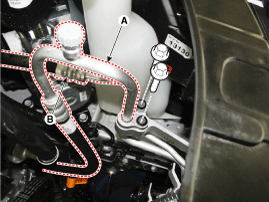
Remove the nuts, and then disconnect the discharge line (A) and liquid line (B) from the condenser.
|
| 4. |
Remove the radiator assembly.
(Refer to Engine Mechanical System - "Radiator") |
| 5. |
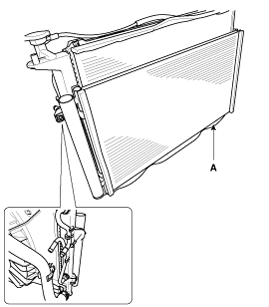
Remove the condenser (A) from radiator assembly.
|
| 6. |
Install in the reverse order of removal.
|

 Compressor Repair procedures
Removal
1.
If the compressor is marginally operable, run the engine at
idle speed, and let the air conditioning work for a few minutes, then
shut the engine off.
2.
Disconnect the negative ...
 Receiver-Drier Repair procedures
Replacement
1.
Remove the condenser.
2.
Remove the cap (B) on the bottom of the condenser with a L wrench (A).
Tightening torque :
2.7 ~ 3.1 N.m (0.28 ~ 0.32 kgf.m, 2.0 ~ 2.3 lb-ft)
...
See also:
Pre-safe seat belt (PSB) (if equipped)
The purpose of the pre-safe seat belt is to tighten the seat belt during emergency
braking, or when a loss of control is sensed.
CAUTION
The pre-safe seat belt activates only when the passenge ...
Description and Operation
Description
Evaporative Emission Control System prevents fuel vapor
stored in fuel tank from vaporizing into the atmosphere. When the fuel
evaporates in the fuel tank, the vapor passes through ...
Emergency Fastening Device (EFD) Repair procedures
Removal
1.
Disconnect the battery negative cable, and wait for at least three minutes before beginning work.
2.
Remove the front seat assembly.
(Refer to Body - "Front Seat Assembly")
3. ...
Categories
Hyundai Equus Manuals

© 2011-2026 Copyright www.heqmanual.com