
 Hyundai Equus: Recommended SAE viscosity number
Second generation VI (2009–2026) / Hyundai Equus 2009-2026 Owners Manual / Specifications, Consumer information and Reporting safety defects / Recommended lubricants and capacities / Recommended SAE viscosity number
Hyundai Equus: Recommended SAE viscosity number
Second generation VI (2009–2026) / Hyundai Equus 2009-2026 Owners Manual / Specifications, Consumer information and Reporting safety defects / Recommended lubricants and capacities / Recommended SAE viscosity number
CAUTION
Always be sure to clean the area around any filler plug, drain plug, or dipstick before checking or draining any lubricant. This is especially important in dusty or sandy areas and when the vehicle is used on unpaved roads. Cleaning the plug and dipstick areas will prevent dirt and grit from entering the engine and other mechanisms that could be damaged.
Engine oil viscosity (thickness) has an effect on fuel economy and cold weather operating (engine start and engine oil flowability). Lower viscosity engine oils can provide better fuel economy and cold weather performance, however, higher viscosity engine oils are required for satisfactory lubrication in hot weather.
Using oils of any viscosity other than those recommended could result in engine damage.
When choosing an oil, consider the range of temperature your vehicle will be operated in before the next oil change. Proceed to select the recommended oil viscosity from the chart.
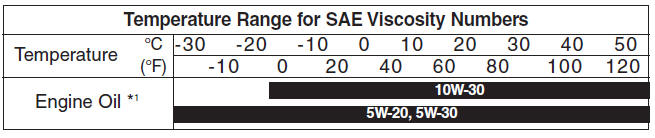
 Recommended lubricants and capacities
To help achieve proper engine and powertrain performance and durability, use
only lubricants of the proper quality.
The correct lubricants also help promote engine efficiency that results in improv ...
 Vehicle identification number (VIN)
The vehicle identification number (VIN) is the number used in registering your
car and in all legal matters pertaining to its ownership, etc.
The number is punched on the floor under the front ...
See also:
TPMS Sensor Description and Operation
Description
1.
General description
(1)
WU is a sensor placed in the tire that reports pressure and temperature.
(2)
The WU is mounted inside the wheels, fixed to the valve. The angle between ...
Lane Departure Warning System (LDWS) Unit Components and Components Location
Components
...
Smart Cruise Control Unit Components and Components Location
Component Location
...
Categories
Hyundai Equus Manuals
