
 Hyundai Equus: Rear Stabilizer Bar Repair procedures
Second generation VI (2009–2026) / Hyundai Equus VI 2009-2026 Service Manual / Suspension System / Rear Suspension System / Rear Stabilizer Bar Repair procedures
Second generation VI (2009–2026) / Hyundai Equus VI 2009-2026 Service Manual / Suspension System / Rear Suspension System / Rear Stabilizer Bar Repair procedures
| Removal |
| 1. |
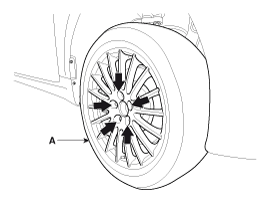
Remove the rear wheel and tire (A) from rear hub .
|

| 2. |
Disconnect the rear stabilizer link (B) from the rear lower arm by loosening the nut (A)
|

| 3. |
Loosen the mounting bolt (A) and then remove the stabilizer bar (B).
|

| 4. |
Disconnect the rear stabilizer link (B) with the stabilizer bar (A).
|

| 5. |
Install in the reverse order of removal.
|
| Inspection |
| 1. |
Check the bushing for wear deterioration. |
| 2. |
Check the all bolts. |
| 3. |
Check the stabilizer bar for deformation. |
 Rear Lower Arm Repair procedures
Removal
1.
Remove the rear wheel and tire (A) from rear hub .
Tightening torque:
88.3 ~ 107.9 N.m (9.0 ~ 11.0 kgf.m, 65.1 ~ 79.6 lb-ft)
•
Be careful not to damage ...

See also:
Side Impact Sensor (SIS) Components and Components Location
Components
...
Gate operator & Canadian programming
During programming, your handheld transmitter may automatically stop transmitting.
Continue to press the Integrated HomeLink® Wireless Control System button (note
steps 2 through 4 in the Standar ...
Compressor Components and Components Location
Components
1. Dyer2. Motor3. Connected to tube4. Reverse valve connector5. Connector for motor driveing
...
Categories
Hyundai Equus Manuals

© 2011-2026 Copyright www.heqmanual.com