
 Hyundai Equus: Engine Coolant Temperature Sensor (ECTS) Description and Operation
Second generation VI (2009–2026) / Hyundai Equus VI 2009-2026 Service Manual / Engine Control/Fuel System / Engine Control System / Engine Coolant Temperature Sensor (ECTS) Description and Operation
Hyundai Equus: Engine Coolant Temperature Sensor (ECTS) Description and Operation
Second generation VI (2009–2026) / Hyundai Equus VI 2009-2026 Service Manual / Engine Control/Fuel System / Engine Control System / Engine Coolant Temperature Sensor (ECTS) Description and Operation
Second generation VI (2009–2026) / Hyundai Equus VI 2009-2026 Service Manual / Engine Control/Fuel System / Engine Control System / Engine Coolant Temperature Sensor (ECTS) Description and Operation
| Description |
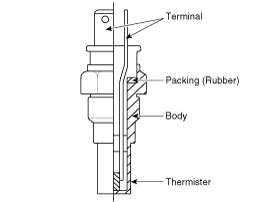
Engine Coolant Temperature Sensor (ECTS) is located in the
engine coolant passage of the cylinder head for detecting the engine
coolant temperature. The ECTS uses a thermistor that changes resistance
with the temperature.
The electrical resistance of the ECTS decreases as the
temperature increases, and increases as the temperature decreases. The
reference +5V is supplied to the ECTS via a resistor in the ECM. That
is, the resistor in the ECM and the thermistor in the ECTS are connected
in series. When the resistance value of the thermistor in the ECTS
changes according to the engine coolant temperature, the output voltage
also changes.
During cold engine operation, the ECM increases the fuel
injection duration and controls the ignition timing using the
information of engine coolant temperature to avoid engine stalling and
improve drivability.
 Intake Air Temperature Sensor (IATS) Repair procedures
Inspection
1.
Connect the GDS on the Data Link Connector (DLC).
2.
Measure the output voltage of the MAPS at idle and IG ON.
Specification: Refer to "Specification"
...
 Engine Coolant Temperature Sensor (ECTS) Specifications
Specification
TemperatureResistance (kx)°C°F-40-4048.14-20-414.13 ~ 16.830325.7920682.31 ~ 2.59401041.15601400.59801760.32
...
See also:
Blind spot detection system (BSD) (If equipped)
The BSD (Blind spot detection) system uses a radar sensor to alert the driver
while driving.
It senses the rear side territory of the vehicle and provides information to
the driver.
(1) BSD (B ...
Troubleshooting
Troubleshooting
Category Error symptoms inspection item Detailed inspection item Related partsLighting
•
HUD not working
•
Lighting brightness not automatically controlled (no diff ...
Battery Sensor Description and Operation
Description
Vehicles have many control units that use more electricity.
These units control their own system based on information from diverse
sensors. It is important to have a stable power s ...
Categories
Hyundai Equus Manuals

© 2011-2026 Copyright www.heqmanual.com