
 Hyundai Equus: Rear-Facing child restraint
Second generation VI (2009–2026) / Hyundai Equus 2009-2026 Owners Manual / Safety features of your vehicle / Child restraint system / Rear-Facing child restraint
Hyundai Equus: Rear-Facing child restraint
Second generation VI (2009–2026) / Hyundai Equus 2009-2026 Owners Manual / Safety features of your vehicle / Child restraint system / Rear-Facing child restraint
WARNING
NEVER install a child or infant restraint in the front passenger's seat. Placing a rear-facing child restraint in the front seat can result in SERIOUS INJURY or DEATH if the child restraint is struck by an inflating air bag.
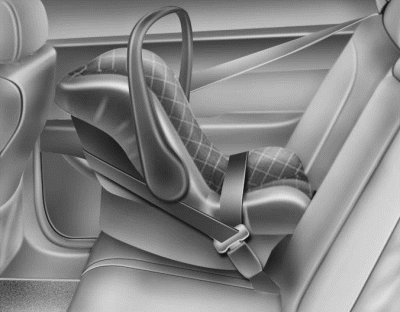
A rear-facing child restraint provides restraint with the seating surface against the back of the child. The harness system holds the child in place, and in an accident, acts to keep the child positioned in the restraint and reduce the stress to the fragile neck and spinal cord.
All children under age one must always ride in a rear-facing child restraint. There are different types of rear-facing child restraints: infantonly seats can only be used rear-facing.
Convertible and 3-in-1 child restraints typically have higher height and weight limits for the rear-facing position, al-lowing you to keep your child rear-facing for a longer period of time.
Keep using restraints in the rear-facing position as long as children fit within the height and weight limits allowed by the child restraint's manufacturer. It's the best way to keep them safe. Once your child has outgrown the rear-facing child restraint, your child is ready for a forward-facing child restraint with a harness.
 Child restraint system
Children under age 13 must always ride in the rear seats and must always be properly
restrained to minimize the risk of injury in an accident, sudden stop or sudden
maneuver. According to accident ...
 Forward-Facing child restraints
A forward-facing child restraint provides restraint for the child's body with
a harness. Keep children in a forwardfacing child restraint with a harness until
they reach the top height or ...
See also:
Propeller Shaft Repair procedures
Inspection
CV Joint and Boots
1.
Shift the transaxle to Neutral.
2.
Raise the vehicle off the ground, and support it with safety stands in the proper locations.
3.
Check the center beari ...
Oil Pump Components and Components Location
Components
1. Oil filter cap2. Oil filter cap O-ring3. Oil filter element4. Oil filter body5. Oil filter assembly gasket6. Oil cooler7. Oil cooler gasket8. Lower oil pan9. Upper oil pan 10. Oil l ...
Specifications
Tightening Torques
ItemN.mkgf.mlb-ftDriver airbag (DAB)7.8 ~ 10.80.8 ~ 1.15.8 ~ 8.0Passenger airbag (PAB)7.8 ~ 11.80.8 ~ 1.25.8 ~ 8.7Side airbag (SAB)6.9 ~ 8.80.7 ~ 0.95.1 ~ 6.5Curtain airbag (C ...
Categories
Hyundai Equus Manuals
