
 Hyundai Equus: Temperature Control Actuator Repair procedures
Second generation VI (2009–2026) / Hyundai Equus VI 2009-2026 Service Manual / Heating, Ventilation and Air Conditioning / Heater / Temperature Control Actuator Repair procedures
Hyundai Equus: Temperature Control Actuator Repair procedures
Second generation VI (2009–2026) / Hyundai Equus VI 2009-2026 Service Manual / Heating, Ventilation and Air Conditioning / Heater / Temperature Control Actuator Repair procedures
Second generation VI (2009–2026) / Hyundai Equus VI 2009-2026 Service Manual / Heating, Ventilation and Air Conditioning / Heater / Temperature Control Actuator Repair procedures
| Inspection |
| 1. |
Turn the ignition switch OFF. |
| 2. |
Disconnect the temperature control actuator connector. |
| 3. |
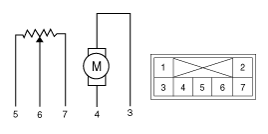
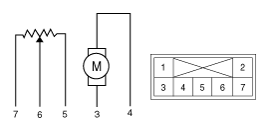
Verify that the temperature control actuator operates to the
warm (Driver's side) or cool (Passenger's side) position when connecting
12V to terminal 3 and grounding terminal 4.
Verify that the temperature control actuator operates to the
cool (Driver's side) or warm (Passenger's side) position when connected
in reverse.
[Driver's side]
[Passenger's side]
|
| 4. |
Connect the temperature control actuator connector. |
| 5. |
Turn the ignition switch ON. |
| 6. |
Check the voltage between terminal 6 and 7 (Driver's side) or 5 (Passenger's side).
Specification
It will feedback the current position of the actuator to controls. |
| 7. |
If the measured voltage is not within specification,
substitute with a known-good temperature control actuator and check for
proper operation. |
| 8. |
Replace the temperature control actuator if it is proved that there is a problem with it. |
| Replacement |
[Driver's side]
| 1. |
Disconnect the negative (-) battery terminal. |
| 2. |
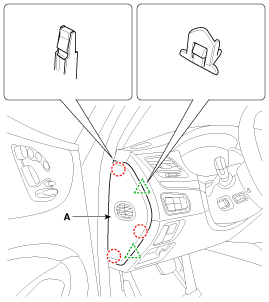
Using a screwdriver or remover, remove the driver's side crash pad side cover.
|
| 3. |
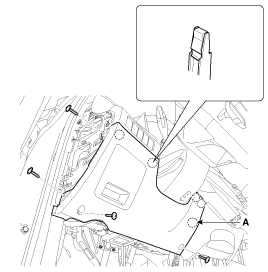
After loosening the mounting screws, remove the crash pad lower panel (A).
|
| 4. |
Disconnect the crash pad lower panel switch connector (A) and knee air bag connector (B).
|

| 5. |
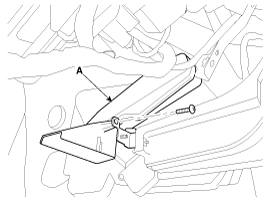
Remove the driver's side shower duct (A) after loosening the screw.
|
| 6. |
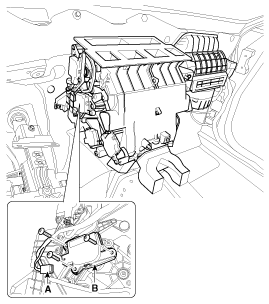
Disconnect the temperature control actuator connector (A),
and then remove the temperature control actuator (B) after loosening the
mounting screws.
|
| 7. |
Install in the reverse order of removal. |
[Passenger's side]
| 1. |
Disconnect the negative (-) battery terminal. |
| 2. |
Remove the cowl side trim.
(Refer to Body - "Cowl Side Trim") |
| 3. |
To remove the crash pad under cover [RH] (A), press both sides of the locking pin and then pull it down.
|

| 4. |
Disconnect the under lamp connector (A).
|

| 5. |
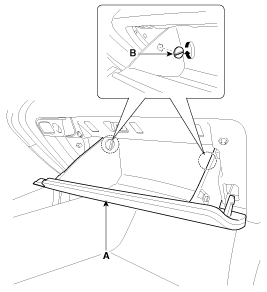
Remove the stopper (B) from the glove box (A).
|
| 6. |
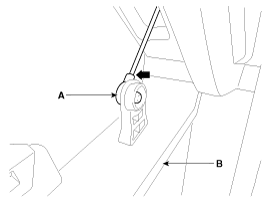
Disconnect the air damper (A) from the glove box (B).
|
| 7. |
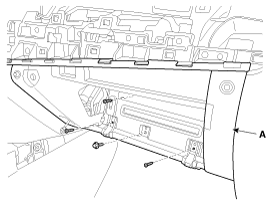
Remove the glove box housing (A) after loosening the mounting screws and nuts.
|
| 8. |
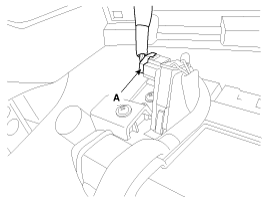
Disconnect the glove box lamp connector (A).
|
| 9. |
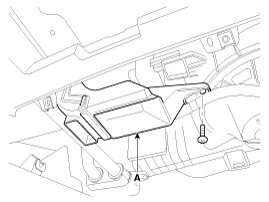
Remove the passenger's side shower duct (A).
|
| 10. |
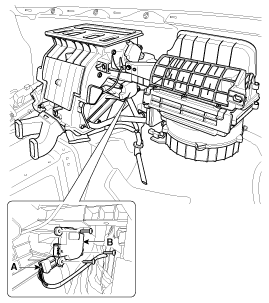
Disconnect the connector (A) and then remove the temperature control actuator (B) after loosening the mounting screws.
|
| 11. |
Install in the reverse order of removal. |
 Temperature Control Actuator Description and Operation
Description
The temperature control actuator is located at the heater unit. It regulates the temperature by the procedure as follows.
The signal from the control unit adjusts the position of the ...
 Mode Control Actuator Description and Operation
Description
The mode control actuator is located at the heater unit.
It adjusts the position of the mode door by operating the
mode control actuator based on the signal of the A/C control unit. ...
See also:
Blower Unit Components and Components Location
Component Location
Components
1. Intake Duct Case2. Intake Duct Case (A)3. Intake Door4. Intake Actuator5. Seal6. Blower Upper Case7. Blower Lower Case8. Seal9. Climate Control Air Filter Cover1 ...
Output Speed Sensor Repair procedures
Inspection
1.
Check signal waveform of output speed sensor using the GDS.
Specification: Refer to "Signal Wave Form" section.
...
Accelerator Position Sensor (APS) Description and Operation
Description
Accelerator Position Sensor (APS) is installed on the
accelerator pedal module and detects the rotation angle of the
accelerator pedal. The APS is one of the most important sensors ...
Categories
Hyundai Equus Manuals

© 2011-2026 Copyright www.heqmanual.com