
 Hyundai Equus: CVVT Oil Control Valve (OCV) Description and Operation
Second generation VI (2009–2026) / Hyundai Equus VI 2009-2026 Service Manual / Engine Control/Fuel System / Engine Control System / CVVT Oil Control Valve (OCV) Description and Operation
Hyundai Equus: CVVT Oil Control Valve (OCV) Description and Operation
Second generation VI (2009–2026) / Hyundai Equus VI 2009-2026 Service Manual / Engine Control/Fuel System / Engine Control System / CVVT Oil Control Valve (OCV) Description and Operation
Second generation VI (2009–2026) / Hyundai Equus VI 2009-2026 Service Manual / Engine Control/Fuel System / Engine Control System / CVVT Oil Control Valve (OCV) Description and Operation
| Description |
Continuous Variable Valve Timing (CVVT) system advances or
retards the valve timing of the intake and exhaust valve in accordance
with the ECM control signal which is calculated by the engine speed and
load.
By controlling CVVT, the valve over-lap or under-lap occurs,
which makes better fuel economy and reduces exhaust gases (NOx, HC) and
improves engine performance through reduction of pumping loss, internal
EGR effect, improvement of combustion stability, improvement of
volumetric efficiency, and increase of expansion work.
This system consist of
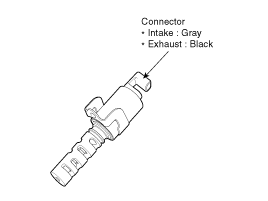
-the CVVT Oil Control Valve (OCV) which supplies the engine
oil to the cam phaser or cuts the engine oil from the cam phaser in
accordance with the ECM PWM (Pulse With Modulation) control signal,
- the CVVT Oil Temperature Sensor (OTS) which measures the engine oil temperature,
-and the Cam Phaser which varies the cam phase by using the hydraulic force of the engine oil.
The engine oil getting out of the CVVT oil control valve
varies the cam phase in the direction (Intake Advance/Exhaust Retard) or
opposite direction (Intake Retard/Exhaust Advance) of the engine
rotation by rotating the rotor connected with the camshaft inside the
cam phaser.
 Purge Control Solenoid Valve (PCSV) Repair procedures
Inspection
1.
Turn the ignition switch OFF.
2.
Disconnect the PCSV connector.
3.
Measure resistance between the PCSV terminals 1 and 2.
4.
Check that the resistance is within the speci ...
 CVVT Oil Control Valve (OCV) Specifications
Specification
ItemSpecificationCoil Resistance (x)6.9 ~ 7.9 [20°C(68°F)]
...
See also:
Specifications
Specification
Ignition System
Ignition Coil
ItemSpecification Primary Coil Resistance (x)0.62 ± 10% [20°C (68°F)]Secondary Coil Resistance (kx)7.0 ± 15% [20°C (68°F)]
Spark Plug
...
Sedan Interior
Interior A
Front inner pillar tooling hole (O9)Cowl cross bar mounting hole (O11)Front door checker mounting hole (O11)Side sill inner reinforcement tooling hole (O7)Seat belt height adjuster upp ...
Description and Operation
Description
System Overview
The larger the size of the door, the harder it is to close
it. Quite often we see people driving with a door not completely closed.
Power door latch addresses the is ...
Categories
Hyundai Equus Manuals

© 2011-2026 Copyright www.heqmanual.com