
 Hyundai Equus: Ambient Temperature Sensor Repair procedures
Second generation VI (2009–2026) / Hyundai Equus VI 2009-2026 Service Manual / Heating, Ventilation and Air Conditioning / Air Conditioning System / Ambient Temperature Sensor Repair procedures
Hyundai Equus: Ambient Temperature Sensor Repair procedures
Second generation VI (2009–2026) / Hyundai Equus VI 2009-2026 Service Manual / Heating, Ventilation and Air Conditioning / Air Conditioning System / Ambient Temperature Sensor Repair procedures
Second generation VI (2009–2026) / Hyundai Equus VI 2009-2026 Service Manual / Heating, Ventilation and Air Conditioning / Air Conditioning System / Ambient Temperature Sensor Repair procedures
| Inspection |
| 1. |
Turn the ignition switch OFF. |
| 2. |
Remove the front bumper.
(Refer to Body - "Front Bumper Cover") |
| 3. |
Disconnect ambient temperature sensor. |
| 4. |
Check the resistance of the ambient temperature sensor
between terminals 1 and 2 whether it changes by changing the ambient
temperature.
Specification
|
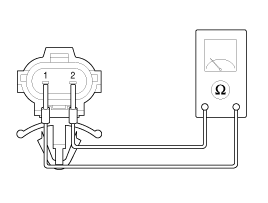
| 5. |
If the measured resistance is not within specification,
substitute with a known-good ambient temperature sensor and check for
proper operation. |
| 6. |
Replace the ambient temperature sensor if it is proved that there is a problem with the sensor. |
| Replacement |
| 1. |
Disconnect the negative (-) battery terminal. |
| 2. |
Remove the front bumper.
(Refer to Body - "Front Bumper Cover") |
| 3. |
Disconnect the smart cruise control unit connector (A). |
| 4. |
Loosen the bolts and then remove the smart cruise control unit bracket (B).
|
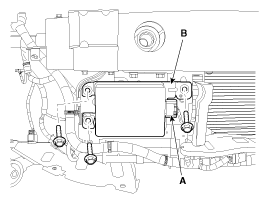
| 5. |
Disconnect the connector and then remove the ambient temperature sensor (A).
[Smart Cruise Control system]
[Non-Smart Cruise Control system]
|
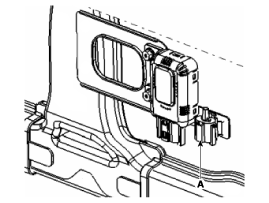
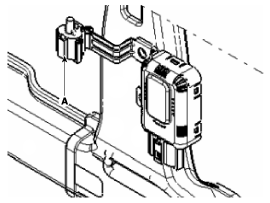
| 6. |
Install in the reverse order of removal. |
 Ambient Temperature Sensor Description and Operation
Description
The ambient temperature sensor is located at the front of the
condenser and detects ambient air temperature. It is a negative type
thermistor; resistance will increase with lower te ...
 Air Quality Sensor (AQS) Description and Operation
Desciption
The Air Quality Sensor (AQS) is located at the center support
in front of the engine radiator. It detects hazardous elements in
ambient air providing output signal to the control.
A ...
See also:
Power Window Switch Components and Components Location
Components
Power Window Main Switch
Assist Power Window Switch
Rear Power Window Switch
...
Parking Assist Sensor Schematic Diagrams
Circuit diagram
...
Filter inspection
The climate control air filter should be replaced every 15,000 miles (24,000
km). If the vehicle is operated in severely air-polluted cities or on dusty rough
roads for a long period, it should be ...
Categories
Hyundai Equus Manuals

© 2011-2026 Copyright www.heqmanual.com