
 Hyundai Equus: Passenger Airbag (PAB) Module Repair procedures
Second generation VI (2009–2026) / Hyundai Equus VI 2009-2026 Service Manual / Restraint / Airbag Module / Passenger Airbag (PAB) Module Repair procedures
Hyundai Equus: Passenger Airbag (PAB) Module Repair procedures
Second generation VI (2009–2026) / Hyundai Equus VI 2009-2026 Service Manual / Restraint / Airbag Module / Passenger Airbag (PAB) Module Repair procedures
| Removal |
| 1. |
Disconnect the battery negative cable and wait for at least three minutes before beginning work. |
| 2. |
Remove the glove box housing.
(Refer to Body - "Glove Box Housing") |
| 3. |
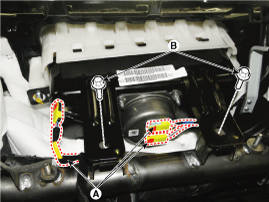
Disconnect the passenger airbag connector (A) and remove the mounting bolts (B).
|
| 4. |
Remove the crash pad.
(Refer to Body - "Main Crash Pad Assembly")
|

| 5. |
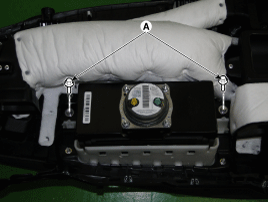
Remove the mounting bolts (A) from the crash pad. Then remove the passenger airbag.
|

| Installation |
| 1. |
Turn the ignition switch OFF. |
| 2. |
Disconnect the battery negative cable from battery and wait for at least three minutes before beginning work. |
| 3. |
Place a passenger airbag on the crash pad and tighten the passenger airbag mounting bolts (A).
|
| 4. |
Install the crash pad.
(Refer to Body - "Main Crash Pad Assembly") |
| 5. |
Tighten the passenger airbag mounting bolts (B).
Connect the passenger airbag harness connector (A) to the SRS main harness connector.
|
| 6. |
Reinstall the glove box housing.
(Refer to Body - "Glove Box Housing") |
| 7. |
Reconnect the battery negative cable. |
| 8. |
After installing the passenger airbag, confirm proper system operation:
Turn the ignition switch ON; the SRS indicator light should turn on for about six seconds and then go off. |

 Side Airbag (SAB) Module Description and Operation
Description
The Side Airbags (SAB) are installed inside the front seat
and protects the driver and passenger from danger when a side crash
occurs. The SRSCM determines deployment of the side ai ...
See also:
Use approved window washer anti-freeze in system
To keep the water in the window washer system from freezing, add an approved
window washer anti-freeze solution in accordance with instructions on the container.Window
washer anti-freeze is availa ...
Intake Air Temperature Sensor (IATS) Description and Operation
Description
Intake Air Temperature Sensor (IATS) is included inside
Manifold Absolute Pressure Sensor and detects the intake air
temperature.
To calculate precise air quantity, correction of t ...
Battery Description and Operation
Description
1.
The CMF(Closed Maintenance Free) battery is, as the name
implies, totally maintenance free and has no removable battery cell
caps.
2.
The CMF(Closed Maintenance Free) batter ...
Categories
Hyundai Equus Manuals
