
 Hyundai Equus: Checking the coolant level
Second generation VI (2009–2026) / Hyundai Equus 2009-2026 Owners Manual / Maintenance / Engine coolant / Checking the coolant level
Hyundai Equus: Checking the coolant level
Second generation VI (2009–2026) / Hyundai Equus 2009-2026 Owners Manual / Maintenance / Engine coolant / Checking the coolant level
WARNING Removing radiator cap

- Never attempt to remove the radiator cap while the engine is operating or hot. Doing so might lead to cooling system and engine damage and could result in serious personal injury from escaping hot coolant or steam.
- Turn the engine off and wait until it cools down. Use extreme care when removing the radiator cap. Wrap a thick towel around it, and turn it counterclockwise slowly to the first stop. Step back while the pressure is released from the cooling system. When you are sure all the pressure has been released, press down on the cap, using a thick towel, and continue turning counterclockwise to remove it.
- Even if the engine is not operating, do not remove the radiator cap or the drain plug while the engine and radiator are hot. Hot coolant and steam may still blow out under pressure, causing serious injury.
WARNING

The electric motor (cooling fan) is controlled by engine coolant temperature, refrigerant pressure and vehicle speed. It may sometimes operate even when the engine is not running. Use extreme caution when working near the blades of the cooling fan so that you are not injured by a rotating fan blades. As the engine coolant temperature decreases, the electric motor will automatically shut off. This is a normal condition. If your vehicle is equipped with GDI, the electric motor (cooling fan) may operate until you disconnect the negative battery cable.
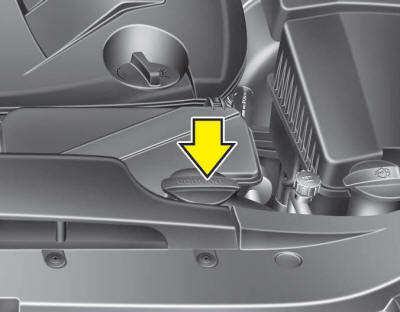
Check the condition and connections of all cooling system hoses and heater hoses. Replace any swollen or deteriorated hoses.

The coolant level should be filled between F and L marks on the side of the coolant reservoir when the engine is cool.
If the coolant level is low, add enough distilled (deionized) water. Bring the level to F, but do not overfill. If frequent additions are required, see an authorized EQUUS dealer for a cooling system inspection.
Recommended engine coolant
- When adding coolant, use only deionized water, distilled water or soft water for your vehicle and never mix hard water in the coolant filled at the factory. An improper coolant mixture can result in serious malfunction or engine damage.
- The engine in your vehicle has aluminum engine parts and must be protected by an ethylene-glycolbased coolant to prevent corrosion and freezing.
- DO NOT USE alcohol or methanol coolant or mix them with the specified coolant.
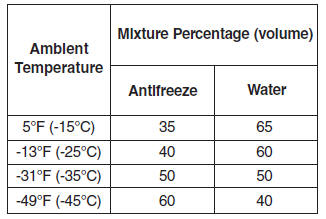
- Do not use a solution that contains more than 60% antifreeze or less than 35% antifreeze, which would reduce the effectiveness of the solution.
- 50% water and 50% antifreeze mix is the easiest to mix together as it will be same quantity of each and can work reasonable for most situations.
For mixture percentage, refer to the following table.
✽ NOTICE
If in doubt about mix ratio 50% water and 50% antifreeze mix is the easiest to mix together as it will be same quantity of each. It can work reasonable for most temperature range of -31°F and higher.
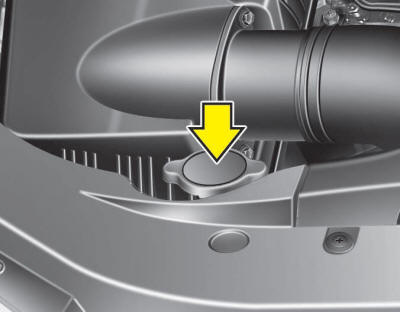
WARNING Radiator cap

Do not remove the radiator cap when the engine and radiator are hot. Scalding hot coolant and steam may blow out under pressure causing serious injury.
 Engine coolant
The high-pressure cooling system has a reservoir filled with year-round antifreeze
coolant. The reservoir is filled at the factory.
Check the antifreeze protection and coolant level at least once a ...
 Changing the coolant
Have coolant changed by an authorized EQUUS dealer according to the Maintenance
Schedule at the beginning of this section.
CAUTION
Put a thick cloth around the radiator cap before refilling the co ...
See also:
License plate lamp replacement
1.Open the trunk.
2.Disconnect the negative battery cable.
3.Using a screwdriver, remove the trunk lid latch cover(1).
4.Using a screwdriver, remove the trunk lid switch(2), and disconnect ...
Description and Operation
Description
Emissions Control System consists of three major systems.
•
Crankcase Emission Control System prevents blow-by gas from
releasing into the atmosphere. This system recycles gas ...
Exhaust Manifold Repair procedures
Removal and Installation
1.
Disconnect the negative terminal (A) from the battery.
Tightening torque :
3.9 ~ 5.9 N.m (0.4 ~ 0.6 kgf.m, 2.9 ~ 4.3 lb-ft)
2.
Remove the engine room cover (A ...
Categories
Hyundai Equus Manuals
