
 Hyundai Equus: Evaporator Temperature Sensor Repair procedures
Second generation VI (2009–2026) / Hyundai Equus VI 2009-2026 Service Manual / Heating, Ventilation and Air Conditioning / Air Conditioning System / Evaporator Temperature Sensor Repair procedures
Hyundai Equus: Evaporator Temperature Sensor Repair procedures
Second generation VI (2009–2026) / Hyundai Equus VI 2009-2026 Service Manual / Heating, Ventilation and Air Conditioning / Air Conditioning System / Evaporator Temperature Sensor Repair procedures
Second generation VI (2009–2026) / Hyundai Equus VI 2009-2026 Service Manual / Heating, Ventilation and Air Conditioning / Air Conditioning System / Evaporator Temperature Sensor Repair procedures
| Inspection |
| 1. |
Turn the ignition switch OFF. |
| 2. |
Disconnect the evaporator temperature sensor connector. |
| 3. |
Measure the resistance between terminal “+� and “-� of the evaporator temperature sensor.
Specification
|
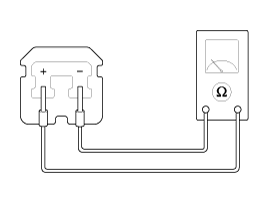
| 4. |
Connect the evaporator temperature sensor connector. |
| 5. |
Run the engine and turn the A/C switch ON, then measure the voltage between the terminals of the harness connector. |
| Replacement |
| 1. |
Disconnect the negative (-) battery terminal. |
| 2. |
Remove the cowl side trim.
(Refer to Body - "Cowl Side Trim") |
| 3. |
Remove the crash pad under cover (A) by pressing the locking pin.
|

| 4. |
Disconnect the under lamp connector (A).
|

| 5. |
Remove the stopper (B) from the glove box (A).
|
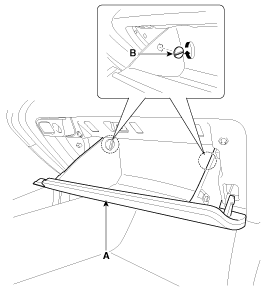
| 6. |
Disconnect the air damper (A) from the glove box (B).
|
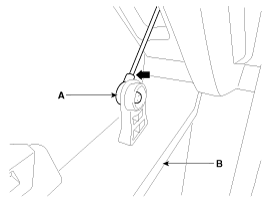
| 7. |
Remove the glove box housing (A) after loosening the mounting screws and nuts.
|
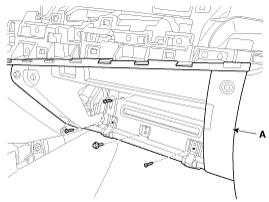
| 8. |
Disconnect the glove box lamp connector (A).
|
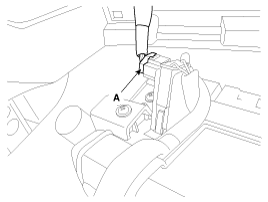
| 9. |
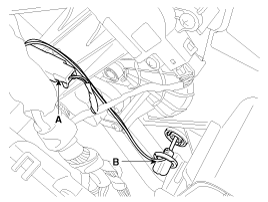
Disconnect the evaporator temperature sensor connector (A),
and then remove the evaporator temperature sensor (B) by pulling it out
after rotating it 90° in a counterclockwise direction.
|
| 10. |
Install in the reverse order of removal. |
 Evaporator Temperature Sensor Description and Operation
Description
The evaporator temperature sensor will detect the evaporator
core temperature and interrupt compressor relay power in order to
prevent evaporator from freezing by excessive cooling. ...
 In-car Sensor Description and Operation
Description
An in-car air temperature sensor is located in the heater control.
The sensor contains a thermistor which measures the
temperature of the cabin. The signal determined by the resistan ...
See also:
Cowl Cross Bar Assembly Repair procedures
Replacement
•
Put on gloves to protect your hands.
•
When prying with a flat-tip screwdriver, wrap it with
protective tape, and apply p ...
Spliter Unit Components and Components Location
Components
...
ESP OFF Switch Description and Operation
Description
1.
The ESP OFF switch is for the user to turn off the ESP system.
2.
The ESP OFF lamp is on when ESP OFF switch is engaged. ...
Categories
Hyundai Equus Manuals

© 2011-2026 Copyright www.heqmanual.com